The internet has made it possible for businesses in Kolkata to reach customers far beyond India. Whether you run an e-commerce business, IT company, travel agency, educational service, SaaS business, or professional service, international customers can become an important part of your growth strategy.
However, reaching international audiences through organic search requires more than simply translating your website into another language. Search behaviour, keywords, cultural preferences, and user intent can vary significantly from one country to another.
This is where multilingual SEO becomes important. For businesses in Kolkata, multilingual SEO can create opportunities to attract international customers while also helping them connect with multilingual audiences within India.
In this guide, we will explore what multilingual SEO is, how it works, its benefits, common mistakes to avoid, and how businesses in Kolkata can use it to build international organic visibility.
What Is Multilingual SEO?
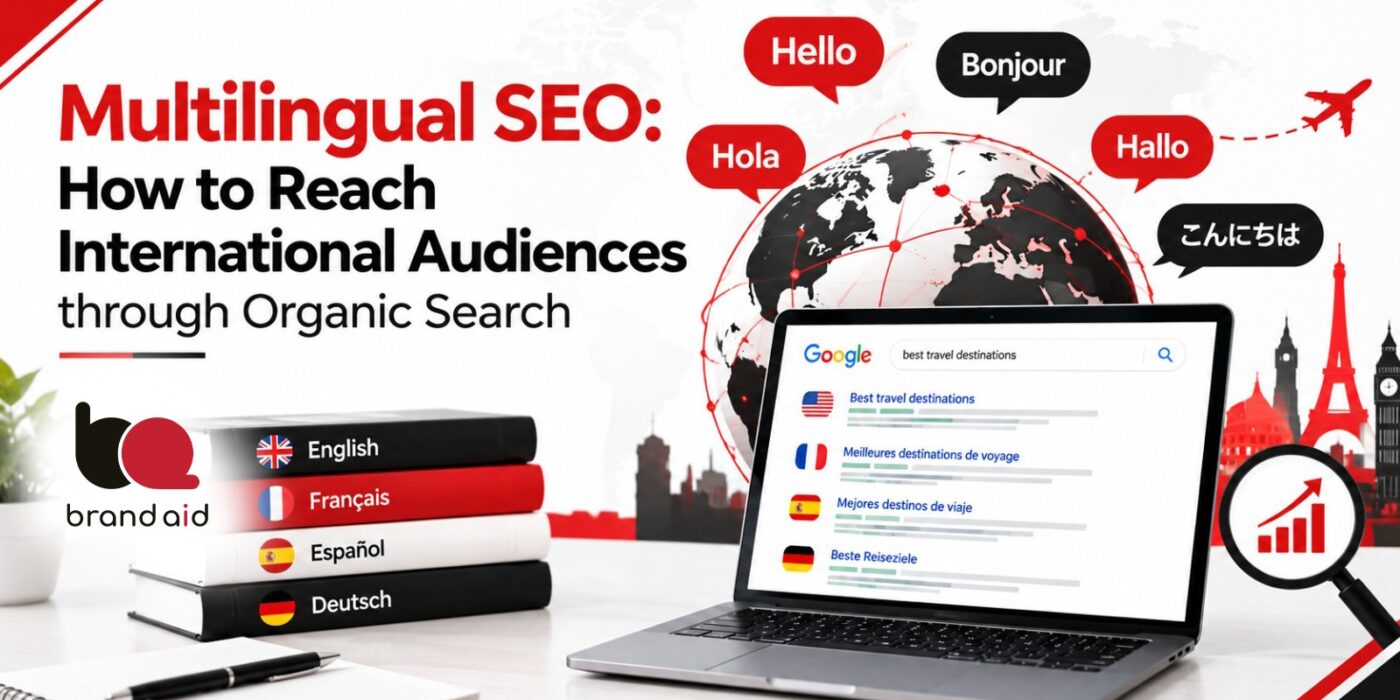
Multilingual SEO is the practice of optimizing website content for people who use different languages when searching online.
For example, a Kolkata-based company may have its primary website in English but want to reach customers searching in:
- Hindi
- Bengali
- French
- Spanish
- German
- Arabic
- Japanese
- Other relevant languages
Simply translating existing pages is not enough. Effective multilingual SEO involves keyword research, localized content, technical SEO, URL structure, metadata, internal linking, and understanding local search intent.
The goal is to ensure that the right audience sees the right version of your website in the right language.
Why Multilingual SEO Matters for Businesses in Kolkata?
Kolkata is home to businesses across technology, manufacturing, education, healthcare, hospitality, finance, retail, and professional services. Many of these businesses have the potential to serve customers outside West Bengal and India.
A strong multilingual SEO strategy can help Kolkata businesses expand their digital reach without depending entirely on paid advertising.
1. Reach International Customers
If your business sells products or services internationally, optimizing content for different languages can help you appear in searches made by customers in other countries.
Instead of competing only for English-language searches, you can create opportunities to rank for relevant searches in multiple languages.
2. Increase Organic Traffic
A website targeting multiple languages can potentially attract visitors from several search markets.
For example, an English page may attract searches from one audience, while its properly localized French or German equivalent can attract users searching in those languages.
This creates additional opportunities to generate organic traffic.
3. Improve User Experience
People generally prefer to research products and services in a language they understand comfortably.
Providing localized content can make it easier for visitors to understand:
- Products and services
- Pricing information
- Features
- Company information
- Contact details
- Shipping or delivery information
- Terms and conditions
A better user experience can contribute to stronger engagement and conversions.
4. Build International Brand Visibility
Ranking consistently for relevant searches in multiple markets can strengthen your brand’s online presence.
For a Kolkata-based company looking to establish itself internationally, multilingual SEO can become a long-term organic growth channel.
Multilingual SEO vs. Multiregional SEO
These two concepts are related but different.
Multilingual SEO focuses primarily on different languages.
Multiregional SEO focuses on targeting users in different geographic locations.
For example:
- English for users in India
- French for users in France
- German for users in Germany
This can involve both language and geographical targeting.
A Kolkata business targeting international customers may need to consider both multilingual and multiregional SEO, depending on its target markets.
How to Build a Multilingual SEO Strategy?
Creating a successful multilingual SEO strategy requires more than translating your existing website. Here are the key steps.
1. Identify Your Target International Markets
Start by deciding which countries and audiences you actually want to reach.
Do not create ten different language versions simply because you can. Focus on markets where there is genuine business potential.
Consider:
- Existing international customers
- Product or service demand
- Search volume
- Competition
- Purchasing power
- Language preferences
- Shipping or service availability
- Business expansion plans
For a Kolkata-based business, the best international market will depend on its industry and offerings.
2. Conduct Multilingual Keyword Research
Keyword research is one of the most important parts of multilingual SEO.
A common mistake is to translate English keywords directly into another language and assume they will have the same search demand.
Search behaviour differs between countries and languages.
For example, a phrase that is popular in English may have a completely different commonly searched expression in French or German.
Research keywords separately for every target language.
Look at:
- Search volume
- Search intent
- Keyword difficulty
- Local terminology
- Long-tail keywords
- Related searches
- Commercial keywords
- Informational queries
The objective is to identify the phrases that real users in each market actually search for.
3. Create High-Quality Localized Content
Translation and localization are not the same.
Translation converts words from one language into another. Localization adapts content to the cultural and linguistic expectations of a specific audience.
For example, localization may involve adapting:
- Examples
- Currency
- Measurements
- Expressions
- CTAs
- Cultural references
- Product information
- Customer support information
A professional multilingual SEO strategy should focus on human-friendly localized content, rather than automated word-for-word translations.
4. Use the Correct URL Structure
Your website needs a clear structure for different language versions.
Common options include:
- example.com/fr/
- fr.example.com
- example.fr
Each approach has advantages and disadvantages.
For many businesses, language-specific subdirectories such as /fr/ or /de/ can be a straightforward way to organize multilingual content.
The most important thing is to maintain a clear, consistent structure that search engines and users can understand.
5. Implement Hreflang Tags Correctly
Hreflang is an important technical SEO element for multilingual websites.
It helps search engines understand that different pages are intended for different language or regional audiences.
For example, you might have:
- English content for an international audience
- French content for French-speaking users
- German content for German-speaking users
Correct hreflang implementation can help search engines serve the appropriate version to users.
However, incorrect hreflang implementation can create confusion and technical SEO problems. Businesses should therefore audit their implementation carefully.
6. Optimize Metadata for Each Language
Every localized page should have its own optimized:
- Title tag
- Meta description
- H1 heading
- Image alt text
- URL
- Structured content
Do not simply copy the English metadata and translate it automatically.
Your metadata should reflect the keywords and search intent of the target audience.
7. Optimize Internal Linking
Internal links help users and search engines navigate your website.
When building a multilingual website, make sure links point to the appropriate language versions.
For example, a French page should generally link to relevant French content rather than unnecessarily sending users to English pages.
Create logical content clusters within each language section.
This can improve navigation, topical relevance, and the overall SEO structure of your website.
Common Multilingual SEO Mistakes to Avoid
Multilingual SEO can deliver strong results, but technical and content-related mistakes can limit performance.
1. Using Automatic Translation Without Review
Machine translation can be useful as a starting point, but publishing automatically translated content without human review can lead to:
- Awkward wordings
- Incorrect terminology
- Cultural mistakes
- Poor readability
- Search intent mismatches
Always review important pages for accuracy and natural language.
2. Targeting Too Many Languages
More languages do not automatically mean more customers.
Creating and maintaining multiple language versions requires resources.
Start with the markets that have the strongest business potential and expand gradually.
3. Duplicating Content Across Language Pages
Translated pages should provide meaningful value to their intended audience.
Avoid creating low-quality pages that exist only to target keywords.
Every language version should offer useful, readable, and relevant information.
4. Ignoring Local Search Intent
Users in different markets may have different expectations.
A keyword may have informational intent in one market and commercial intent in another.
Understanding search intent is therefore essential for multilingual SEO success.
5. Incorrect Hreflang Implementation
Hreflang errors are common on multilingual websites.
Incorrect language codes, missing reciprocal references, or inconsistent URLs can reduce the effectiveness of your implementation.
Technical SEO audits should be part of your ongoing strategy.
How a Kolkata SEO Company Can Help With Multilingual SEO?
For businesses based in Kolkata, working with an experienced SEO company in Kolkata can make multilingual SEO easier to manage.
A professional SEO team can help with:
1. International Keyword Research
SEO specialists can research search behaviour across different countries and languages to identify relevant opportunities.
2. Content Localization
Experienced content professionals can ensure that translated pages sound natural and communicate the intended message effectively.
3. Technical SEO
A multilingual website requires careful technical implementation, including:
- Hreflang
- Canonical tags
- XML sitemaps
- URL structures
- Indexation
- Internal linking
- Page speed
- Mobile optimization
4. Performance Tracking
SEO teams can monitor organic performance by language and market.
Important metrics include:
- Organic traffic
- Keyword rankings
- Click-through rate
- Engagement
- Conversions
- Leads
- Revenue
This data can help determine which markets deserve additional investment.
Multilingual SEO for Kolkata Businesses: A Practical Example
Consider a digital marketing company based in Kolkata that wants to attract international clients.
Its primary website may already target searches such as:
“digital marketing company in Kolkata“
To expand internationally, the company could create dedicated content for markets where it wants to acquire customers.
Instead of simply translating its homepage, it could create localized pages addressing topics such as:
- Digital marketing services
- SEO services
- International SEO
- E-commerce marketing
- Content marketing
- Local SEO
- Technical SEO
Each page can be optimized for the relevant language, keyword set, audience, and search intent.
This approach allows the Kolkata company to position itself not only as a local service provider but also as an agency capable of serving international clients.
Measuring the Success of Multilingual SEO
Multilingual SEO should be measured using business outcomes rather than rankings alone.
Track performance separately for each market and language.
1. Organic Traffic
Monitor how much organic traffic each language section receives.
2. Keyword Rankings
Track relevant keywords in each target country and language.
3. Organic Conversions
Traffic is valuable, but conversions are more important.
Measure:
- Form submissions
- Calls
- Product purchases
- Demo requests
- Enquiries
- Sign-ups
4. Conversion Rate
Compare conversion rates between different language versions.
A page receiving less traffic but generating more qualified leads may be more valuable than a high-traffic page with poor conversions.
5. Revenue
For commercial websites, connect SEO data with revenue wherever possible.
This helps determine the actual business value generated by each target market.
The Future of Multilingual SEO
Search is becoming increasingly global and conversational.
Users are searching through traditional search engines, voice assistants, AI-powered search experiences, and other digital platforms.
As businesses in Kolkata expand internationally, multilingual content can become an important part of their broader organic search strategy.
However, the future of multilingual SEO will not simply be about creating more translated pages.
Successful brands will focus on:
- Search intent
- Helpful content
- Localization
- Technical SEO
- User experience
- Trust
- Conversion optimization
The businesses that understand their international audiences will have a stronger opportunity to compete in global search results.
Conclusion On Multilingual SEO
Multilingual SEO gives businesses in Kolkata an opportunity to move beyond local and English-only search visibility and connect with audiences across international markets.
The process involves much more than translating website content. Effective multilingual SEO requires market research, localized keyword research, quality content, technical optimization, hreflang implementation, strong internal linking, and continuous performance tracking.
For Kolkata businesses planning international growth, the best approach is to start with a few high-potential markets, create genuinely useful localized content, and gradually expand based on measurable results.
With the right strategy, a business operating from Kolkata can use organic search to build visibility, attract qualified international visitors, generate leads, and create long-term digital growth.
Frequently Asked Questions On Multilingual SEO
Q. What is multilingual SEO?
Multilingual SEO is the process of optimizing a website to rank organically for users who search in different languages. It includes keyword research, content localization, technical SEO, metadata optimization, URL structure, and hreflang implementation.
Q. Is translating a website enough for multilingual SEO?
No. Translation alone is not enough. Multilingual SEO requires localized keyword research, content adapted to the target audience, technical optimization, and consideration of local search intent.
Q. Is multilingual SEO useful for businesses in Kolkata?
Yes. Kolkata businesses that want to attract customers outside India can use multilingual SEO to reach international audiences through organic search and reduce their dependence on paid advertising.
Q. What is hreflang in SEO?
Hreflang is an HTML attribute that helps search engines understand which language or regional version of a webpage should be shown to users.
Q. Should I create separate pages for each language?
Yes, in most cases, each language should have its own dedicated URL so that search engines can crawl, index, and understand the content properly.
Q. Can AI translation be used for multilingual SEO?
AI translation can help with initial content creation, but important website content should be reviewed and edited by someone who understands the target language and audience. Quality and natural readability are essential.
Q. How long does multilingual SEO take to show results?
SEO results vary depending on competition, website authority, content quality, technical health, and target market. Multilingual SEO should generally be treated as a long-term organic growth strategy rather than a quick traffic solution.
Q. How can an SEO company in Kolkata help with international SEO?
An SEO company in Kolkata can assist with international keyword research, content localization, technical SEO, hreflang implementation, content strategy, link building, analytics, and ongoing performance optimization.