Search is ever changing. For years, businesses competed for a place on Google’s first page. The goal was straightforward: identify keywords, optimize pages, build backlinks, improve rankings, and attract clicks.
But users are increasingly searching in a different way.
Instead of typing:
“best digital marketing agency in Kolkata”
they may ask:
“Which digital marketing agency in Kolkata would be suitable for a small business that wants SEO and AI search visibility?”
The difference is important.
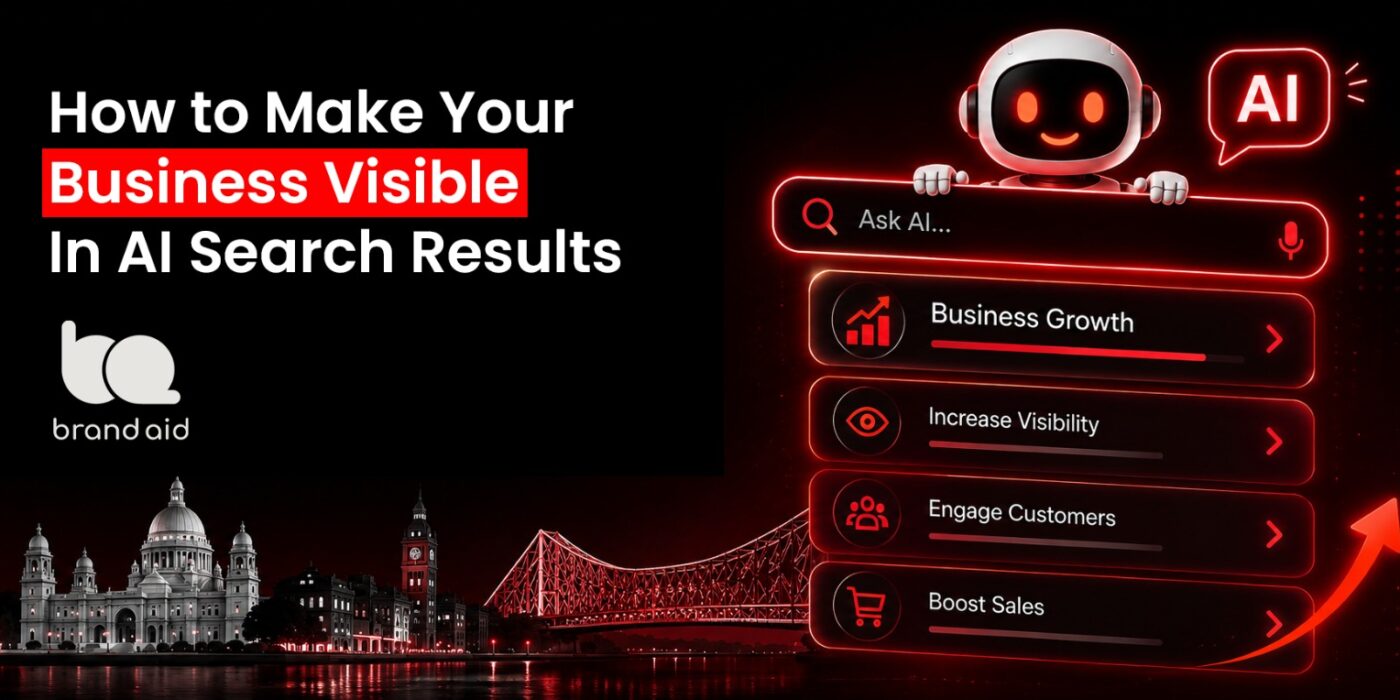
Traditional search usually gives users a list of websites. AI-powered search can interpret the question, compare information from multiple sources, and provide a summarized answer.
That means your business now needs to be visible not only as a webpage but as a credible source of information that AI systems can understand, trust, and potentially reference.
This is where AI search visibility, SEO, and Answer Engine Optimization (AEO) come together.
The businesses that adapt early won’t simply ask, “How do I rank?”
They will start asking:
“How do I become one of the businesses that AI considers when answering a relevant question?”
What Is AI Search?
AI search refers to search experiences that use artificial intelligence to understand queries and generate direct, conversational responses.
Traditional search largely works around matching a user’s query with relevant webpages.
AI-powered search goes further by trying to understand:
- What the user actually wants
- The context behind the question
- Related concepts and entities
- Different sources of information
- The intent behind a conversational query
- Which information appears trustworthy and useful
Examples include AI-generated search experiences and conversational AI platforms where users can ask detailed questions rather than relying on short keyword searches.
Consider the difference.
A traditional query might be:
A conversational query could be:
“What should a Kolkata-based healthcare business look for when choosing an SEO agency?”
The second query contains considerably more context.
For businesses, this creates a new visibility challenge.
You are no longer optimizing only for keywords. You are building a digital information footprint that helps search systems understand what your business does, who it serves, where it operates, and why it deserves consideration.
Why AI Search Visibility Matters for Businesses?
AI search changes the path between searching and choosing.
Previously, a potential customer might see ten blue links, visit three websites, compare them and eventually contact a business.
AI-generated answers can shorten that journey.
A user may receive a synthesized answer containing:
- Recommended businesses
- Product or service comparisons
- Relevant providers
- Supporting information
- Reasons for a recommendation
- Sources used to construct the answer
This creates a new competitive advantage.
Visibility can happen before the website visit
Your customer may encounter your business name while asking an AI system for recommendations before ever searching for your website directly.
Brand authority becomes increasingly important
When multiple independent sources consistently associate your brand with a specific service, location, expertise, or category, AI systems gain stronger context to accurately understand and represent your business.
Search intent is becoming more detailed
People can now ask longer, more specific questions.
This gives businesses opportunities to create content around real problems and decision-making situations, rather than producing hundreds of pages targeting slightly different keyword variations.
AI visibility complements, not replaces, traditional search
AI search isn’t a reason to abandon Google rankings.
In fact, strong organic visibility, technically accessible content, structured information, local signals, and credible third-party references can all contribute to a stronger overall search presence.
The strategy is therefore not:
SEO vs AI search.
It is:
SEO + AEO + entity authority + useful content + local relevance.
How to Make Your Business Visible in AI Search Results
There is no guaranteed method to make an AI system mention a particular business.
However, businesses can make their digital presence significantly easier for search systems to understand and evaluate.
Here are the areas that deserve the most attention.
1. Build Content Around Questions, Not Just Keywords
One of the biggest mistakes businesses make is creating content around keyword volume alone.
For example, a company might create a page targeting:
“SEO Company in Kolkata”
But a potential customer may actually be asking:
- How much does SEO cost in Kolkata?
- What should a local business expect from an SEO agency?
- How long does local SEO take?
- Should a startup hire an SEO agency or freelancer?
- What should I check before hiring an SEO company?
- How can SEO generate leads instead of just traffic?
These are decision-making questions.
Your content should address them directly.
Instead of creating another generic “What is SEO?” article, build resources that answer the questions your prospects are genuinely asking before purchasing.
This increases the number of meaningful contexts in which your brand can become relevant.
2. Create Answer-Friendly Content
AI systems need information they can interpret.
That doesn’t mean reducing every article to short answers. It means making important information easy to identify.
Use:
- Clear headings
- Direct answers
- Descriptive subheadings
- Concise explanations
- Comparison tables where appropriate
- Step-by-step processes
- FAQs
- Definitions
- Examples
- Supporting evidence
For example, don’t hide your answer inside a 700-word introduction.
If someone asks:
“Does local SEO help businesses with physical locations?”
Answer the question clearly first, then explain the reasoning.
This structure works for humans and machines.
3. Strengthen Your Business Entity
AI search doesn’t only need to understand your webpage.
It needs to understand your business.
Make your brand information consistent across your digital ecosystem.
Important signals can include:
- Business name
- Website
- Location
- Services
- Contact information
- Social profiles
- Business directories
- Professional profiles
- Reviews
- Publications
- Industry mentions
- Author information
If your website says one thing, your business profiles say another, and third-party websites contain outdated information, search systems have a less consistent picture of your entity.
Think beyond individual pages.
Build a recognizable digital identity for the business as a whole.
4. Publish First-Hand Expertise
AI search makes generic content easier to reproduce.
That makes original expertise more valuable.
Instead of writing:
“SEO is important because it increases visibility.”
Show what your business has actually learned.
For example:
- Campaign observations
- Industry-specific strategies
- Before-and-after analysis
- Original research
- Data-backed findings
- Expert commentary
- Real implementation examples
- Common mistakes observed in projects
- Practical frameworks
This is where Experience becomes particularly important.
A hundred websites can explain what local SEO is.
Far fewer can explain:
“What we learned after optimizing multiple location-based businesses and which local signals made the biggest difference.”
That distinction gives your content a stronger reason to exist.
5. Earn Mentions Beyond Your Own Website
Your website saying “we are experts” is one signal.
Other credible sources independently describing your business as relevant to a particular service or industry can provide a different kind of context.
Consider building legitimate brand mentions through:
- Industry publications
- Interviews
- Expert contributions
- Local business platforms
- Relevant directories
- Podcasts
- Professional communities
- Partnerships
- Digital PR
- Guest contributions on genuinely relevant websites
The goal isn’t to generate hundreds of meaningless mentions.
The goal is to create relevant, consistent and credible associations around your brand.
Strengthen Your E-E-A-T Signals, Combine SEO With AEO
E-E-A-T—Experience, Expertise, Authoritativeness and Trustworthiness—has become increasingly important for businesses producing information online.
But it shouldn’t be treated as a checklist.
It should influence how your business communicates expertise.
Experience
Show that your business has actually worked in the area you’re discussing.
Use:
- Case studies
- Campaign insights
- Original observations
- Client outcomes where appropriate
- Practical examples
Expertise
Make expertise visible.
Author bios, professional backgrounds, credentials, detailed explanations and specialist content can help demonstrate who is behind the information.
Authoritativeness
Authority isn’t created by publishing 500 blog posts.
It develops through consistent expertise, strong references, reputable mentions, quality content and recognition within a relevant field.
Trustworthiness
Make it easy for users to verify your business.
Provide accurate:
- Contact information
- Company details
- Service descriptions
- Author information
- Policies
- Customer information
- Business location
Where AEO fits in?
SEO helps your content become discoverable.
AEO focuses more heavily on making information useful and understandable for systems designed to provide direct answers.
A practical strategy combines both.
SEO asks:
“How can this page become discoverable for relevant searches?”
AEO asks:
“How can this information directly answer the user’s question in a way that search and AI systems can understand?”
You need both.
Focus on Local Search Visibility
For businesses serving specific locations, local visibility becomes especially important.
Consider a user asking:
“Which AEO company in Kolkata can help a local business improve its visibility in AI search?”
The location is not incidental.
It is part of the user’s intent.
Your local strategy should therefore go beyond simply adding “Kolkata” to page titles.
Build genuine local relevance through:
- Google Business Profile optimization
- Consistent NAP information
- Local landing pages
- Location-specific content
- Customer reviews
- Local citations
- Relevant Kolkata publications
- Local business mentions
- Service-area information
- Location-based case studies
For example, an SEO company in Kolkata should demonstrate more than the ability to rank for the phrase “SEO company in Kolkata.”
It should demonstrate an understanding of the Kolkata market, local customer behavior, competitive landscape and business environment.
That is a much stronger form of local relevance.
The Future of Business Discovery Is Becoming More Conversational
The biggest shift may not be technical at all.
It is behavioral.
People are becoming comfortable asking machines questions the way they would ask another person.
Instead of searching:
“best CRM for startups”
they can ask:
“Which CRM would you recommend for a five-person startup that needs automation but has a limited budget?”
Instead of:
“SEO agency Kolkata”
they may ask:
“Which SEO agencies in Kolkata have experience with local lead generation?”
The second type of query requires considerably more context.
This means businesses should begin thinking about their online presence as a knowledge ecosystem.
Your website, business profiles, reviews, content, authors, PR mentions, case studies and third-party references should tell a consistent story.
The question is no longer simply:
“Can Google find my website?”
It is becoming:
“Can search systems understand what my business is known for?”
That is the strategic opportunity.
Businesses that establish clear expertise and strong entity-level signals now may be better positioned as conversational search continues to evolve.
How BrandAid Digital Can Help Your Business?
AI search optimization isn’t about publishing a few FAQ pages and hoping ChatGPT or another AI platform mentions your brand.
It requires a broader search strategy.
At BrandAid Digital, we approach AI search visibility by connecting traditional SEO with content strategy, AEO, local search and brand authority.
Our approach can include:
1. SEO Foundation
We strengthen the technical and on-page foundations required for search engines to crawl, understand and evaluate your website.
2. AEO-Focused Content
We identify meaningful questions around your products, services and industry and structure content to provide clear, useful answers.
3. Entity & Brand Optimization
We work on the signals that help establish what your business does, where it operates and what topics it should be associated with.
4. Local SEO
For businesses targeting Kolkata or other specific locations, we develop location-focused strategies that go beyond simply inserting city names into content.
5. E-E-A-T Strategy
We help make experience, expertise and trust more visible through content, authorship, case studies and supporting brand signals.
6. Content Strategy
Instead of chasing every keyword, we build content around customer journeys-from informational questions to high-intent commercial decisions.
The objective is simple:
Make your business easier for both people and search systems to discover, understand and trust.
If you’re looking for an SEO company in Kolkata that understands the shift from traditional search toward AI-powered discovery, BrandAid Digital can help build a strategy around your actual business goals.
Frequently Asked Questions On AI Search
1. What is AI search visibility?
AI search visibility refers to how easily an AI-powered search or answer system can discover, understand and potentially reference a business, website, product or expertise when generating answers to relevant user questions.
It goes beyond ranking for individual keywords. It involves building a consistent digital presence around your business, expertise, services, location and relevant topics.
2. Is traditional SEO still important for AI search?
Yes.
AI search does not make SEO obsolete. Technical accessibility, quality content, internal linking, structured information, authority, relevance and organic search visibility remain important parts of a strong digital presence.
The difference is that businesses should now combine traditional SEO with AEO, entity optimization, local SEO and stronger first-hand content.
3. What is the difference between SEO and AEO?
SEO primarily focuses on improving a website’s visibility in search engines.
AEO, or Answer Engine Optimization, focuses on making information easier for answer-driven search experiences to understand and use when responding to user questions.
In practice, the two strategies overlap significantly.
SEO helps search systems discover and evaluate your content, while AEO places greater emphasis on clear, direct and context-rich answers.
4. How can a business improve its chances of appearing in AI-generated answers?
There is no guaranteed formula for being mentioned by an AI system.
However, businesses can improve their overall discoverability by:
- Creating genuinely useful, question-focused content
- Demonstrating first-hand experience
- Strengthening E-E-A-T signals
- Maintaining consistent business information
- Building relevant third-party mentions
- Improving local search visibility
- Establishing clear topical expertise
- Maintaining a technically strong website
- Combining SEO with AEO
The key is to build a credible digital footprint rather than optimize for one AI platform alone.
5. Can an AEO Company in Kolkata help with AI search optimization?
Yes.
An experienced AEO company in Kolkata can help businesses identify conversational search opportunities, develop answer-focused content, strengthen entity and local signals, and integrate AEO with an existing SEO strategy.
However, AEO should not operate separately from SEO.
The strongest strategy connects technical SEO, content, local visibility, E-E-A-T, brand authority, and answer optimization into one search ecosystem.
Conclusion On How to Make Your Business Visible in AI Search Results
AI search is changing how people discover businesses.
But the fundamental principle remains familiar:
Businesses that provide useful information and establish genuine authority are easier to discover and trust.
The difference is that discovery is becoming more conversational.
Your potential customer may no longer ask Google to show them ten websites. They may ask an AI system to explain their options and recommend the most suitable ones.
That creates a new challenge for businesses-and a significant opportunity.
Don’t optimize only to be ranked.
Build a digital presence that can be understood, trusted and associated with the questions your customers are asking. That is the foundation of AI search visibility.